
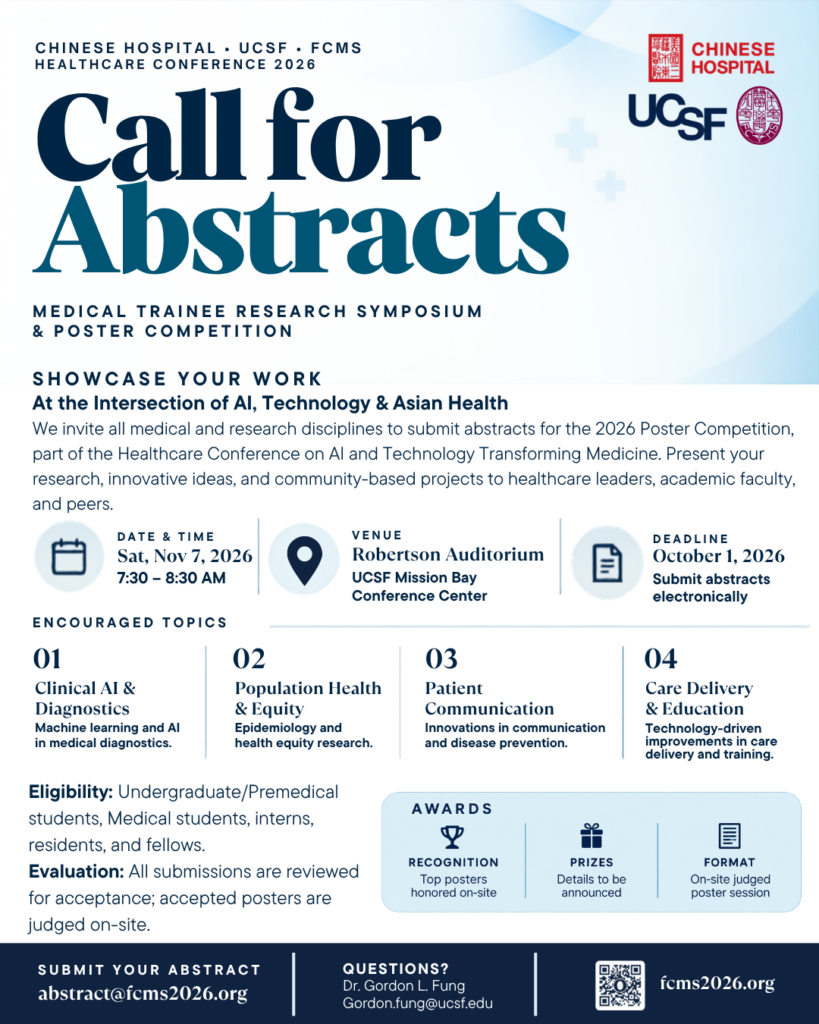
| Calling all medical trainees: submit your abstract Are you a medical student, intern, resident, or fellow? We invite you to submit an abstract for our Medical Trainee Research Symposium & Poster Competition. Share your research, innovative ideas, and community-based projects with healthcare leaders, academic faculty, and peers. Top submissions will receive award prizes, presented on-site. Deadline: October 1, 2026 • Submit to: [email protected] |
Abstract Submission Guidelines
Abstracts should be 300 words or fewer, excluding title and author information. Poster submission is not required at this stage.
Please include:
- Title
- Authors and affiliations
- Trainee status: Medical student, resident, fellow, graduate student, or postdoctoral fellow
- Submission category: Original Research; Clinical Case/Case Series; or QI/Implementation/Education
For Original Research and QI/Implementation Projects
Please organize the abstract using the following headings:
- Background — Clinical or scientific problem and rationale
- Objective — Primary question or objective
- Methods — Study design, population/data source, AI methodology or tool used, comparator where appropriate, and primary outcomes
- Results — Principal findings, including quantitative results whenever available
- Conclusions — Interpretation, clinical significance, limitations, and potential implications
For Clinical Cases
Please organize the abstract using:
- Background — Why the case and AI application are noteworthy
- Case — Concise clinical presentation and relevant use of AI
- Outcome — Clinical course and outcome, where applicable
- Discussion — What the case demonstrates about AI-assisted medicine
- Learning Points — Two to three key lessons
AI-Specific Information (if AI in medicine is the focus of the research)
Authors should provide sufficient information to understand and reproduce the work where feasible, including:
- AI model, platform, or system used
- Model/version, if known and relevant
- Whether the model was locally developed, open source, commercially available, or publicly accessible
- How the AI system was used within the study or clinical workflow
- Nature of human oversight
- Comparator or reference standard, when applicable
- Relevant performance metrics
- Known limitations or potential sources of bias